Critical considerations in provincial territorial spatial planning in China: a qualitative and spatial analysis
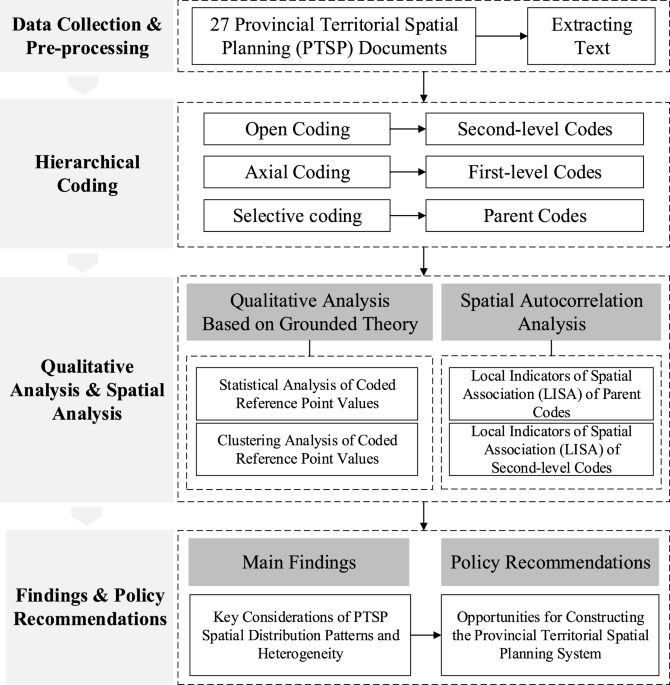
In this study, we systematically coded and visualized the texts of 27 provincial territorial spatial plans (public notice version) in China using a qualitative analysis approach. By leveraging the grounded theory approach for qualitative analysis, we developed a substantive theoretical framework aimed at uncovering the regular patterns, structures, and interrelations embedded within the text material. Meanwhile, the application of LISA in local spatial autocorrelation analysis enabled the revelation of specific planning key considerations. This approach is particularly valuable for policy decision-makers at the national level seeking to discern and interpret the development of provinces, as well as to explore the potential interconnections that may exist between different provinces.
Overall, this study has three main findings. First, Chinese territorial spatial planning at the provincial level is mainly focused on macro-programmatic content, with a keen interest in spatial strategies, positioning and objectives, and regional major facilities. Notably, some provinces underscore the imperative of cross-provincial collaboration under the guidance of regional strategic development. Second, planning documents across various provinces show a significant degree of similarity, particularly in their focus on sustainable development. Common focal points include macro strategies, development goals, ecological preservation, agricultural development, and infrastructure guarantees. Third, a significant spatial correlation is evident in the key content of regional provincial territorial spatial plans, particularly in local spatial correlations. Xinjiang (XJ) stands out as the most prominent province where agriculture, external influence, major regional safety and disaster prevention facilities, and regional transportation facilities are paramount local concerns. Eastern coastal provinces like Zhejiang (ZJ) show distinct spatial clustering, with a high emphasis on planning platform support and external influence, yet there is a notable lack of focus on organizational mechanisms and major transportation facilities.
PTSP occupies a higher level in China’s territorial spatial planning system, which determines that its content has a programmatic characteristic. On one hand, the territorial spatial planning of a specific province is guided by the national strategy for major functional zones, requiring it to undertake strategic roles and development positioning within broader regional and national-level contexts (Bao et al., 2024; Liu & Zhou, 2021b). On the other hand, it provides a crucial legal basis for local development, aiding in the formulation of a development vision and objectives, and in crafting strategies that are sensitive to the province’s distinct features and developmental requirements (Wang & Shen, 2016). Thus, strategic, coordinating, and restrictive elements become the central focus of PTSP.
It may play a significant role in promoting local development to break through the limitations imposed by administrative divisions on resource circulation and personnel collaboration (Yang, 2024), but current analyses indicate that cross-provincial synergistic development has not been adequately emphasized. The spatial autocorrelation analysis reveals significant spatial disparities in the focus on synergistic development among different provinces. For instance, Xinjiang (XJ) exhibits H-H clustering characteristics such as Agriculture (AGRI), Regional External Transportation Facilities (RETF), and Major Regional Safety and Disaster Prevention Facilities (MRSDPF). -high clustering characteristics in such as Agriculture (AGRI), Regional External Transportation Facilities (RETF), and Major Regional Safety and Disaster Prevention Facilities (MRSDPF). This reflects its role as a frontier province under national strategies like the “Belt and Road” Initiative, where strengthening agricultural foundations, transportation hubs, and safety guarantees is essential to support external synergistic development. These findings align closely with SDG17 emphasis on global partnerships and SDG9 objectives for infrastructure development (Table 2). In contrast, Zhejiang (ZJ) demonstrates H-H clustering in the platform support (PS) node within the support system, highlighting its forward-looking approach to leveraging technological advantages to establish planning implementation platforms. However, its attention to Organizational Mechanisms (OM) and Province Major Transportation Facilities (PMTF) remains insufficient, indicating a need to enhance cross-regional management innovation and transportation network coordination (Table 2). Jiangsu (JS) displays H-L clustering in Organizational Mechanisms (OM), suggesting a unique approach to planning execution mechanisms. Nevertheless, the lack of synergy with neighboring provinces may lead to regional imbalances. These findings underscore the importance of tailored policy interventions to address spatial heterogeneity and promote coordinated development across regions.
It is evident that integrating into globalization processes (Liu et al., 2023), aligning with national development patterns (Song et al., 2021a), fostering regional cooperation (Yang et al., 2022; Yang et al., 2024), participating fully in the industrial division of labor (Liao & Li, 2022; Liu et al., 2020), and promoting the flow of various factors (Ge et al., 2022) are vital for province development. Inter-provincial coordination requires formulating differentiated strategies based on spatial agglomeration characteristics, embedding localized indicators of SDG 9 (Industry, Innovation and Infrastructure) and SDG 17 (Partnerships for the Goals) into the spatial layout and mechanism design of territorial spatial planning. Particular attention should be paid to the radiation-driven effects of high-high (H-H) clusters and the policy empowerment of low-low (L-L) clusters.
The high degree of similarity in the content focus across various provinces can be largely attributed to the transformation in development philosophy, requirements for planning review, and guidance from compilation standards. In terms of development philosophy, China has experienced a profound transition from a rapid and extensive growth model to one predicated on sustainable development, which founded on ecological conservation (Ji et al., 2017; Zhang & Wen, 2008), and the reform of the ecological civilization system has promoted a high level of attention to ecological environmental protection in government decision-making (Wu et al., 2021; Xie, 2020). The Opinions of the Central Committee of the Communist Party of China and the State Council on Establishing a Territorial Spatial Planning System and Supervising Its Implementation clearly stipulates that territorial spatial planning, with the construction of ecological civilization at its core value, should serve as the fundamental basis for all types of development activities. Meanwhile, the “three rural issues”—pertaining to agriculture, rural areas, and farmers—have received significant attention from the Chinese government (Shi & Yang, 2022; Song et al., 2023). The protection of prime farmland and rural development has emerged as a significant concern for all provinces, aligning with the SDG2 objective of advancing agricultural development, thereby providing a robust safeguard for national and regional food security. Specifically, PTSP is manifested through the optimization of ecological patterns, the protection and utilization of ecological resources, the boundary of ecological protection red lines, the establishment of nature reserves, and the protection of agricultural production spaces. In the planning review, the Notice on Comprehensively Carrying Out Territorial Spatial Planning Work, issued by the Ministry of Natural Resources in 2019, clarified the key review objectives for PTSP, such as target status and bottom-line constraints. It has also indicated that spatial development and protection objectives, ecosystem conservation, and the strategic layout of major infrastructure are focal points of the review process (Resources, 2019). As for planning compilation standards, the Guidelines for the Compilation of Provincial Territorial Spatial Plan issued by the Ministry of Natural Resources in 2020 have set forth priorities for plan compilation, which include development strategies, agriculture, ecological space, protection and utilization of cultural and natural heritage, basic support systems, and implementation guarantees. The Technical Specifications for the Compilation of Provincial Territorial Spatial Plan released by the Standardization Administration of China in 2023 is a standardized integration of the pilot experiences of “integration of multiple plans” since 2019, and its core contents (such as ecological protection and regional coordination) are consistent with those of the 2020 Guidelines for Provincial Territorial Spatial Planning Preparation. Although the planning texts analyzed in this study were formulated before the issuance of the Code, their high-frequency focus on ecological security, infrastructure, etc., essentially reflects the planning orientations transmitted by the state through previous pilots and technical guidelines. The relevant review requirements and compilation standards have clarified the basic demands for PTSP content and reflected the current focal points of development management and control at the provincial level.
Local spatial clustering characteristics are intricately linked to factors such as the province’s location, resource endowments, national macro strategies, and related development positioning. Within the current global context, on the one hand, certain western provinces in China have emerged as crucial “rear bases” for the nation’s development, with their stability and tranquility being fundamental roles to the overall stability and growth of the country (Qin et al., 2021; Wang et al., 2020). On the other hand, with the ongoing of China’s opening-up, particularly through policies such as the Belt and Road, it has repositioned some of these western provinces as frontiers for international communication and cooperation (Cao & Alon, 2020; Lu, 2021). The observed spatial disparities indicate that frontier and coastal provinces exhibit distinct developmental trajectories due to their divergent geographical positions and strategic orientations, despite shared commitments to regional inclusive development. Frontier provinces, such as Xinjiang, leverage their unique locational advantages to prioritize infrastructure development and industrial collaboration as key breakthroughs. For instance, the Silk Road Economic Belt policy, offer substantial opportunities for external exchanges and cooperation (Sun et al., 2021; Yang & Hu, 2019), particularly in agricultural collaboration and cross-border infrastructure connectivity with Central Asian countries. This aligns with SDG 17’s emphasis on global partnerships and open cooperation. In contrast, coastal provinces like Zhejiang focus on institutional coordination and the flow of innovative elements, capitalizing on platforms such as the Yangtze River Delta integration to enhance cross-regional policy alignment. Meanwhile, central provinces (e.g., Henan and Jiangxi demonstrate a “L-H” clustering pattern in terms of the Internal Influence (II) and External Influence (EI) of policy orientation, reflecting constraints in their integration into regional development frameworks. These provinces need to clarify their positioning in industrial undertakings and ecological coordination, actively embedding themselves into national-level collaborative initiatives (e.g., the Yangtze River Economic Belt) to capture new opportunities. Therefore, the planning and arrangement of territorial spaces need to be responsive to ecological baseline protection, infrastructure guarantee, and the provision of external functional services, and the content of such plans often exhibits a geographically clustered distribution. In contrast, coastal provinces, which boast more dynamic economies and advanced development, focus more on how to deepen development, how to rely on metropolitan areas to amplify external influence, and how to build new economic growth poles (Feng et al., 2024; Hou et al., 2024). This situation typically necessitates implementing sound planning systems and robust platform support. However, in general, across the spectrum of provinces, whether in the west, center, or east, the construction of major infrastructure network systems, the protection of ecological and environmental integrity, planning system guarantees, and spatial strategies to respond to promote opening-up and regional neighborhood collaborative development should all be emphasized.
Drawing on the findings and discussions of this study, we propose some relevant policy recommendations. Firstly, we advocate for fully considering collaborative planning among adjacent provinces geographically. This collaborative approach should encompass robust communication and coordination mechanisms in key areas such as conservation and utilization of the environment, industrial linkage development, major transportation and infrastructure, and the division of labor and cooperation with important national or regional development strategies. These efforts can be strategically aligned with indicators related to SDG9 (Industry, Innovation, and Infrastructure) and SDG17 (Partnerships for the Goals), thereby promoting the localization of specific sustainable development goals. For example, some provinces can integrate industrial synergy, cross-border transportation hubs, and ecological corridor development to bridge SDG9 (Sustainable Infrastructure) and SDG17 (Partnerships). For instance, Xinjiang could capitalize on the Belt and Road Initiative to establish cross-border agricultural cooperation demonstration zones. This would facilitate the integration of intelligent cold-chain logistics hubs with Central Asian grain supply chains, thereby linking the improvement rate of cross-border agricultural product circulation efficiency with SDG9 sustainable infrastructure development targets. Secondly, we emphasize the need for provincial territories to embrace sustainable development modes that strike a balance between conservation and economic growth. A focus on improving infrastructure, protecting the ecological environment, and developing the agricultural industry can effectively contribute to achieving SDG2 (Zero Hunger) and SDG9 targets at the provincial level. In addition, the establishment of planning coordination mechanisms and platforms is essential for the effective formulation and execution of PTSPs. These mechanisms should be complemented by the development and refinement of local technical regulations that are attuned to each province’s unique characteristics and needs. By doing so, we can ensure that provincial development is sustainable and responsive to the specific challenges and opportunities presented by each province.
We contribute a novel integrated approach combining qualitative analysis and spatial analysis to provincial-level territorial spatial planning research. Utilizing Nvivo 12 software, a three-tier coding system (open coding-axial coding-selective coding) was constructed to systematically deconstruct the core elements of 27 provincial territorial spatial planning texts. This approach transcends the limitations of traditional text analysis limited to semantic levels, thereby identifying key issues—such as ecological security pattern optimization, cultivated land resource protection, and regional coordination mechanisms—along with their logical interrelation networks. We incorporated local Moran’s I index and cluster analysis to reveal the spatial cluster characteristics of policy attention at the provincial level innovatively. This hybrid methodology, integrating qualitative and spatial analysis, not only addresses the neglect of spatial dimensions in conventional qualitative research but also compensates for the lack of semantic depth in purely spatial analysis, thereby providing creative empirical support for deciphering the spatial patterns of policy diffusion.
There still remain several limitations. Firstly, our research is predicated on the public notices of planning documents, which highly summarize the core planning information for public consumption and may potentially omit some detailed planning information. As future disclosures of the full texts of China’s PTSPs become available, these documents will undoubtedly serve as material for further detailed analysis. Secondly, this analysis focuses on the provincial level, and it will be necessary to conduct analyses and discussions on planning texts at other levels in the future, such as at the municipal, county, and township levels. However, it is worth emphasizing that this study is still the first comprehensive review based on China’s territorial spatial planning texts (public notice version), which offer policymakers and planners a better understanding of the intentions and priorities of planning at the provincial level.
link