Naples Beach Club sculptures: Unique design elements | Development
A series of sculptures with multiple missions will come to Gulf Shore Boulevard at the nascent Naples Beach Club resort, if City Council approves spending public arts money for them.
All five works received the recommendations of the Design Review Board Sept. 29, with some unique conditions. But this series is unique, and it was a textbook case of components the board must include in its deliberations.
One of its major pieces, a first U.S. commission from European artist Guillaume Castel, is a vertical, mirror-finish stainless steel piece fused to self-sealing Cor-ten steel. The concave shape of the mirrored side brought worries from board member Chae DuPont about its potential to become a 13-foot-tall fire starter.
“Mr. Castel’s piece, I presume, is not concave enough that it’s going to start a fire across the way or burn someone, right?” she asked Wright Harvey, consultant to the company developing the Beach Club.
“I don’t believe so. This sculpture is based on a series of work that he’s produced in several locations and there’s not been an issue to date,” Harvey said.
“That’s not reassuring,” Dupont replied. “This is a concave mirror, right? It will refract, and could cause fires, right?”
Harvey offered to add that to the specifications an engineer was working on, so that in addition to withstanding hurricane-force winds, the sculpture would be set at an angle that would eliminate that possibility. DRB member Irma Sefa add another requirement to protect drivers who would pass its planned location on Golf Drive from reflections, “to make sure it does not, from a safety perspective, does not impact either traffic or cause any not safe conditions.”
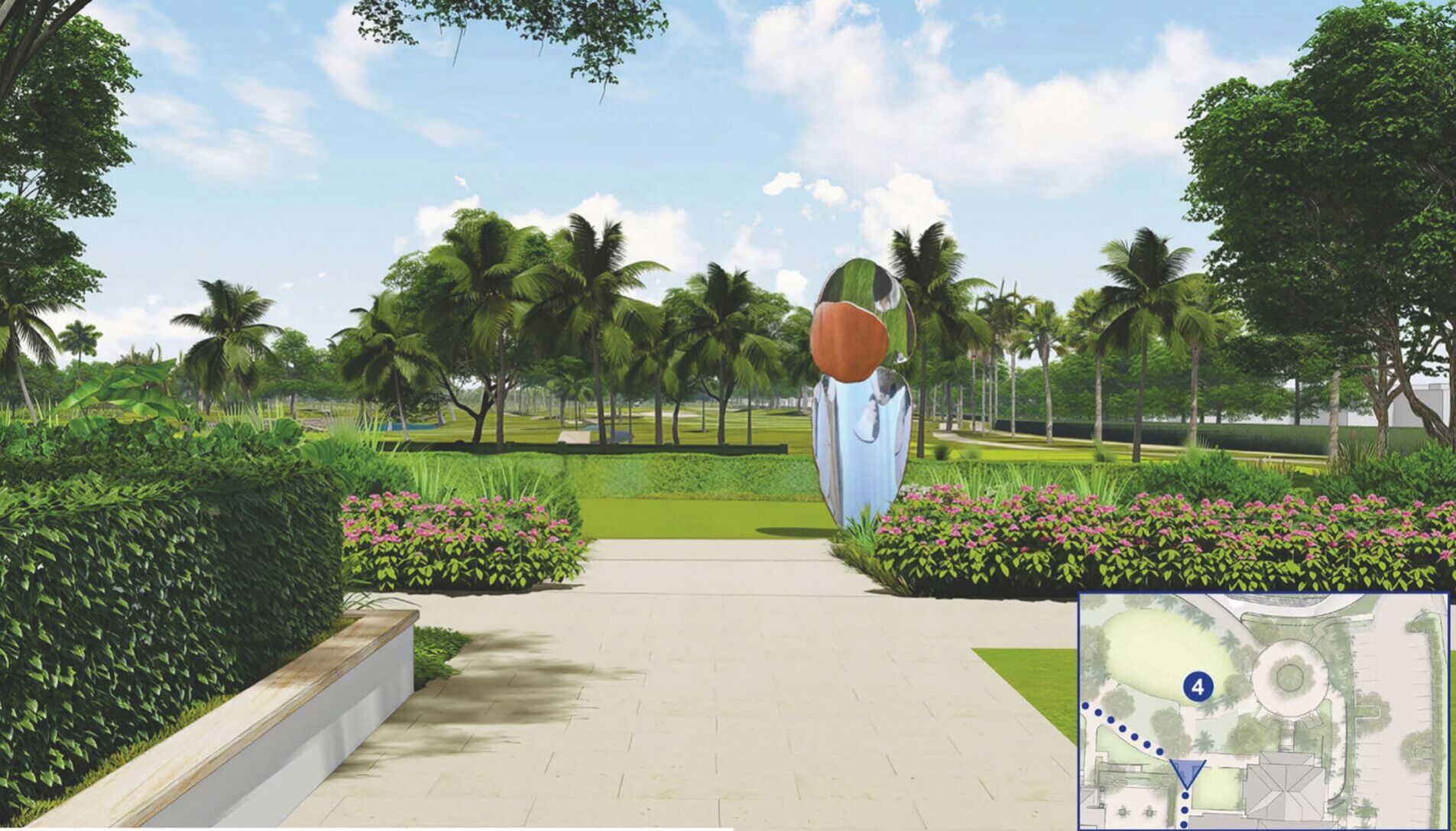

Guillaume Castel’s “Samare” will stand at the south entrance to the Naples Beach Club golf course.
The hub for Naples
Generally, however, the board liked the spirit and style of the sculpture, which the French-speaking Castel, who lives in Brittany, titled “Samare.” In French, that denotes a winged seed that can spread its fruit. It’s an appropriate symbol for the Naples Beach Club, according to Harvey’s explanation.
“Historically, it’s on the same land as the Naples Hotel, which was really an early draw for visitors who converted into residents, and [it] really became a cultural hub of Naples,” he said. Henry and Mary Watkins, who owned the hotel, helped found The Naples Players, and held the group’s first meetings in their home.
Henry’s name materializes on one of the other four sculptures, which are an homage to the Gulf Coast’s avians and its most famous shell. Three speak to the environment in general — a pair of juvenile blue herons grazing at the entrance to the club and a 50-inch tall adult blue heron, with blue-coated wings, in the entrance to what will be called Market Square, a garden opening to a conference center. The resting pelican that will greet visitors to H.B.’s on the Gulf side of the club goes by the name Henry, for Henry Watkins, patriarch of the former hotel there.
“We developed a little bit of lore about Henry, which is [that] this bronze pelican spends his day flying up and down the Gulf Coast, but lands right in front of H.B.’s to watch the sunset every night from his favorite perch,” Harvey told the board.
That brought up another request.
“One thing you didn’t mention here, which is I think the most important thing, is the QR codes at the base of each sculpture. I’d be very interested to scan and hear what those things say, because it should be what you were just talking about,” DRB chairman Stephen Hruby told Harvey. “Art tells the expression of the artist. It also has the ability to tell a story and tell a story of a legacy of a place that it’s in.”
Connections everywhere
The sculptures are full of connections, Harvey agreed. He is one of them.
“This project is very important to me, because Naples is important to me. I grew up here. My family, my parents still live here. And I bring my family here several times a year,” he said. “I learned to love the environment in Naples. I remember camping out at Keewaydin [Island] when I was a kid and being woken up by a park ranger who showed us, with flashlights, a loggerhead turtle mother laying her eggs.”
The sculptor of the bronze works also has local ties, he added. Although David H. Turner isn’t from Naples, the Virginia artist’s realistic animals are in at least three Naples locations, including three at The Conservancy and Youth Haven; a pair of bronze blue herons stalk the Park Shore fountain at U.S. 41, as well. For several years, Turner sponsored a sculpture auction at the Naples Beach Hotel to benefit Youth Haven.
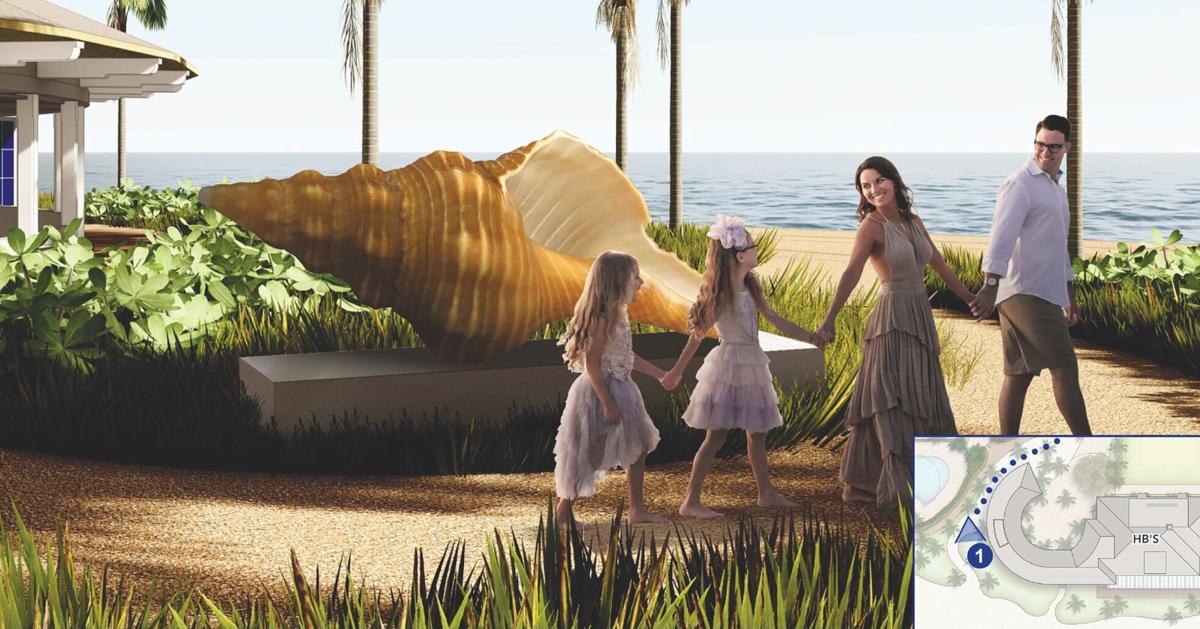
Probably the piece with the most magnetism, however, will be Turner’s 4-foot tall sculpture of a horse conch, which will stand at the beach entrance to the club. It’s an instant photo op, and, Harvey predicted, the backdrop for many future Christmas cards.
But the caramel-shaded mollusk may have a dire reminder in its QR code: These creatures are the state shell of Florida and they are facing extinction, Harvey told the group.
“And as a Floridian, I was embarrassed that I didn’t know that. Not only that, I realized that there’s been a very precipitous population decline, even over the last 30 years, and that this species isn’t actually on any endangered species list,” he said. “There are, however, biologists and marine biologists at FGCU, University of Florida, who are working on this problem. But I think one of the first problems is just a lack of awareness, even among Floridians such as myself.”
Conversation at the meeting indicated that the QR code plaques at its base will not only give the viewer some physical attributes of the conch but point out its perilous state.
The sculptures were estimated as a group for the entire Beach Club complex and would use the entire amount collected by the city for public art funds from its components, approximately $465,373. The original public art application was $688,000. Although two sculptures in that application do not appear in the final list, the total still exceeds the allotment; the company would pay for that, according to Naples Director of Planning Erica Martin.
The Naples Beach Club is scheduled to open this fall but had not received its certificate of occupancy as of Oct. 2. The sculptures must be added within six months of CO issuance.
link