Pragmatic Elements: An Introduction to PRECIS-2
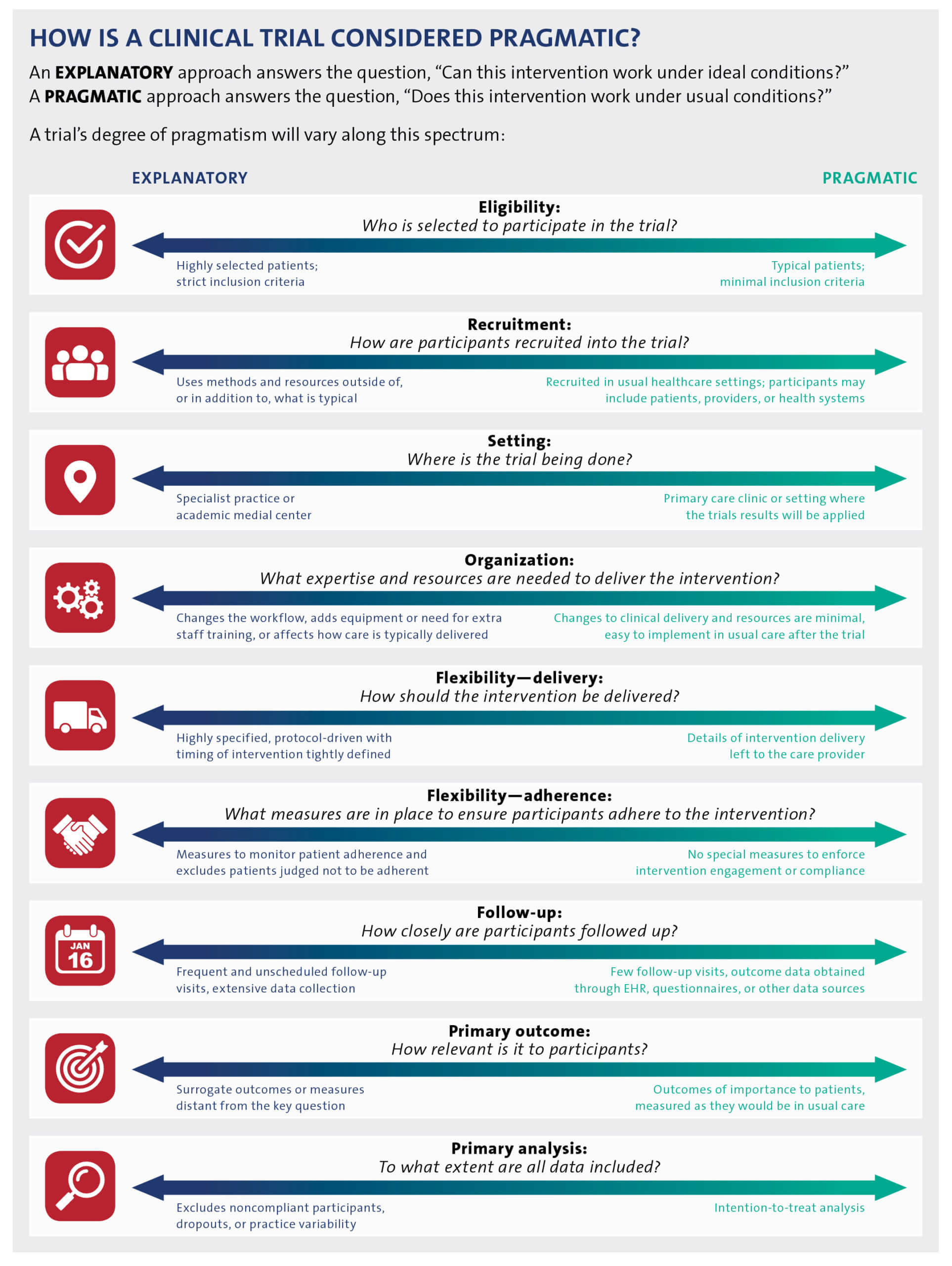
Pragmatic clinical trials are designed to study health interventions in real-world settings that are similar or identical to the settings where the interventions will be implemented. Pragmatic trials thus stand in contrast to explanatory, or traditional, trials, which are usually designed to demonstrate the safety or efficacy of an intervention under highly controlled conditions and in carefully selected groups of participants.
Most clinical trials are situated somewhere along the spectrum between pragmatic and explanatory. The Pragmatic–Explanatory Continuum Indicator Summary (PRECIS; revised in 2015 as PRECIS-2) offers a framework to guide study teams to consider in advance the pragmatic or explanatory nature of their trial across 9 domains (Loudon et al 2015). By 2024, the tool had been cited almost 700 times since its publication (Platt et 2024).
Watch the video module: How Do You Design Trials That Are Fit for Purpose?
Pragmatic-Explanatory Continuum
While pragmatic clinical trials are designed to answer important, real-world clinical questions, trade-offs in flexibility, adherence, and generalizability are inevitable. A pragmatic trial may have both elements that are more pragmatic and elements that are more explanatory. When planning the trial, it is essential to first ask, “What is the best trial design to answer the question of interest?” There is nothing inherently better or worse about a pragmatic trial as compared with a traditional design. Rather, investigators should choose the degree of pragmatism for each element of the design (Figure) that will best answer the research question of interest. To evaluate the degree to which a trial is pragmatic, study teams are encouraged to read the detailed explanations of PRECIS-2, along with examples of how to apply the tool (Loudon et al 2015).
PRECIS-2 Wheel Diagram
In 2016, members of the NIH Pragmatic Trials Collaboratory’s Health Care Systems Interactions Core and colleagues applied the PRECIS-2 criteria to 5 of the NIH Collaboratory Trials. Each trial was found to be “highly pragmatic” across the PRECIS-2 domains. The exercise highlighted the PRECIS-2’s usefulness in guiding decisions about study design but also revealed a number of challenges in applying the tool and interpreting the results (Johnson et al 2016). For example, during the conduct of the PROVEN trial, members of the study team applied the PRECIS-2 domains in a novel manner to assess how dynamic adaptations shifted implementation to either a more explanatory or a more pragmatic approach (Palmer et al 2018).

The Table illustrates key characteristics of interventions that are more pragmatic than explanatory.
Table. Characteristics of Pragmatic Trials
| Trial element | Pragmatic characteristic | Example |
| Research question | Tests whether the intervention is effective in routine clinical practice |
|
| Setting | Embedded in the routine care setting such as primary care, community clinics, hospital units, or healthcare systems |
|
| Participants | Eligible population requires little selection beyond the clinical indication of interest |
|
| Intervention and comparator | Compares two or more real-world treatments using flexible protocols |
|
| Outcomes | Endpoints are clinically relevant to participants, funders, communities, and healthcare providers |
|
| Clinical importance | Purposely designed for making healthcare decisions in settings in which the intervention will be implemented |
|
Elements adapted from Zwarenstein et al (2008).
link