Thread design optimization of a dental implant using explicit dynamics finite element analysis
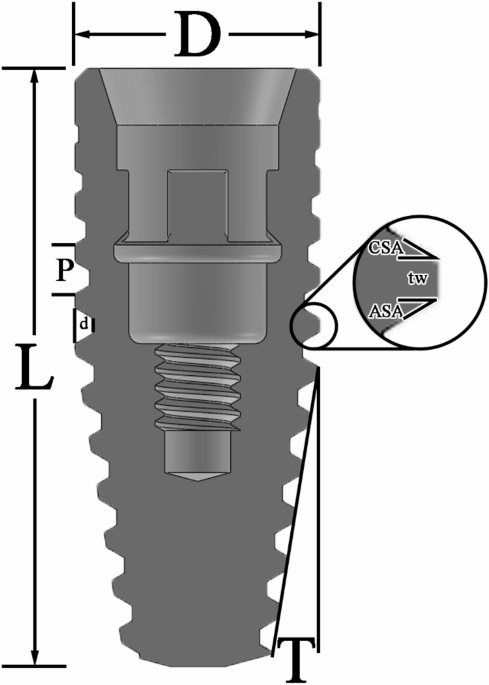
The null hypothesis was rejected based on the results of the present study. For the maxillary posterior region, the optimal thread design is 0.8-mm pitch, 0.2-mm depth, 0.15-mm TW, 10-degree CSA, and 10-degree ASA with the FσvM of 74.56 MPa. The optimal thread design for the mandibular posterior region is 1.0-mm pitch, 0.3-mm depth, 0.2-mm TW, 0-degree CSA, and 20-degree ASA with the FσvM of 78.53 MPa. The BLT implant has a thread with 0.8-mm pitch, 0.3-mm depth, 0.2-mm TW, 0-degree ASA, and 20-degree CSA, resulting in 76.40-MPa and 83.81-MPa FσvM in the maxillary and mandibular sites, respectively, which was higher than that produced by the implant with optimized thread design in the corresponding site.
Most previous FEA studies on dental implants focused on the stress in the implant and peri-implant bone after the abutment or the restoration had been installed. Static FEA was usually utilized in those studies3,11,27,39. However, implantation is a dynamic process. Conventional static FEA cannot accurately describe the interaction between the components in motion during the implantation process in the system40. Therefore, it is essential to conduct dynamic FEA when the implantation process is being examined13.
Alveolar bone can be classified into four types according to its density: dense cortical bone (D1), porous cortical and coarse cancellous bone (D2), porous cortical bone (thin) and fine cancellous bone (D3), and fine cancellous bone (D4)41,42. Among all these four alveolar bone types, D2 bone and D3 bone are the most commonly seen types, with D2 being the most common type in the mandibular posterior region and D3 being the most common type in the maxillary posterior region43Therefore, the present study selected D2 and D3 bones for the FEA model of the alveolar bone in the mandibular and maxillary posterior regions, respectively.
The FEA results of the present study showed that the thread design significantly affects the stress in the peri-implant bone generated during and immediately after implantation. The ongoing implantation process continuously generated stress at the implant-bone interface. As the stress could not be dispersed immediately, it accumulated and reached the peak (PσvM), which was concentrated in the implant bed. On the other hand, the FσvM was more often found on the outer surface of the implantation site, which indicated that the 0.5-s relief of the residual stress was sufficient, and the FσvM could better reflect the influence of the thread design on the stress in the peri-implant bone.
According to Frost’s mechanostat theory, the stress in the alveolar bone should be in a particular range to avoid bone damage or disuse-induced resorption44. Typically, the stress should be in the range of 2 MPa to 60 MPa, which includes the adaptive window and mild overload window of the bone, to maintain bone modeling44. The σvM in the cancellous bone in all the groups was found in this range (Table S1). However, the PσvM and FσvM in the cortical bone were both in the pathological overload window (between 60 MPa and 120 MPa). This high stress in the cortical bone may cause high MBL in the first year and result in most implant failures within the first few years of implantation. On the other hand, stress in the pathological overload window promotes the formation of woven bone, which usually occurs 5 days after implantation44,45. Due to its lack of organization and structure, woven bone is weaker than lamellar bone and cannot provide as adequate support to the implant as the latter46. This may account for the early decrease in implant stability after implantation47,48The “smaller the better” strategy was applied in the orthogonal experiment to assess the stress in the peri-implant cortical bone. Therefore, the PσvM and FσvM in the cortical bone were selected as the test indicators for the range analysis in the orthogonal experiment, and the design with the lowest k of all five factors was designated as “the optimal design”.
During the implantation, not only the geometry of the implant but also the insertion speed, the torque applied to the implant, and the frictional force at the implant-bone interface would alter the stress in the peri-implant bone49,50. Despite the same rotation speed and frictional coefficient, the different pitches resulted in inconsistent pressure and varied frictional force at the implant-bone interface. Perhaps because of these unstudied factors, which also affect the stress in the peri-implant bone, the optimized model based on PσvM failed to obtain the lowest PσvM. On the other hand, due to the sufficient relief of residual stress, it was supposed that the primary influential factor of FσvM was the geometry of the implant. Thus, the optimized model derived from the FσvM achieved the lowest FσvM. Furthermore, several measures can be adopted to reduce the PσvM in the peri-implant bone during implantation, such as lowering insertion speed, drilling intermittently, and applying no axial force. Nevertheless, the FσvM remains in the peri-implant bone, whose influence will exist persistently throughout the bone remodeling process. Hence, the FσvM is the pivotal indicator to evaluate the effect of implant geometry on the stress in the peri-implant bone.
Since the D3 bone had a thinner cortical portion than the D2 bone, the peri-implant bone in the maxillary site was more liable to deform than that in the mandibular site. On the other hand, the thinner cortical portion also resulted in better transmission of stress51. Thus, the maxillary and mandibular sites exhibited different responses to the implant of the same thread design. The OPT-max implant had identical thread depth to the OPT-man implant but had lower pitch, TW, and ASA, and higher CSA than the OPT-man implant.
The orthogonal experiment revealed that the most influential design element for the stress generated in the peri-implant bone during the implantation process was the ASA of the thread. When the ASA rises, a decrease-increase trend of the stress was observed both in the maxillary and mandibular sites. During the implant placement, the ASA is the first portion to contact the alveolar bone. Small ASA will produce a sharp edge, amplify the pressure at the implant-bone interface, and generate high stress in the peri-implant bone. So the stress in the peri-implant bone decreases when the ASA rises. However, as the ASA increases beyond a specific value, the large ASA may extrude a significant amount of bone, thereby increasing the stress in the peri-implant bone. Sadr et al.17 reported that an implant with zero or 35-degree ASA resulted in higher σvM than one with 20-degree ASA in their static FEA study, which is consistent with this work. The OPT-man implant had the same ASA as the original BLT implant, but the ASA of the OPT-max implant was lower than that of the latter. This indicated that the ASA of the BLT implant was suitable for mandibular D2 bone, but could be reduced when used in maxillary D3 bone due to its proneness to deform the surrounding bone.
The second influential design elements were thread pitch and depth. In the maxillary site, the rank of depth was superior to that of pitch, yet inferior in the mandibular site. A decrease-increase trend of the stress was observed both in the maxillary and mandibular sites with the decreasing pitch. Decreased thread pitch will increase the thread density in a specific region of the implant, expand the bone-implant contact area, facilitate the load transfer at the interface, and thereby reduce the stress in the peri-implant bone35. However, higher thread density will cause more bone deformation during implantation. Thus, the stress in the peri-implant bone increased when the pitch continued to decrease. Compared to the original BLT implant, the OPT-max implant had the same pitch, while the pitch of the OPT-man implant was higher. Since the thinner cortical portion in the maxillary D3 bone resulted in better stress transmission, the BLT implant’s pitch was suitable for the maxillary D3 bone. Still, it could be increased to reduce stress concentration when used in the mandibular D2 bone.
Theoretically, when the thread depth increases, the bone-implant contact area will also extend, having the same effect as a decreased thread pitch52However, due to the incomplete bone-implant contact during implantation, a smaller thread depth will make the implant core contact with the deformed bone earlier and limit further bone deformation. Hence, the optimal thread depth is the smallest one investigated either in the maxillary or mandibular site and is smaller than the thread depth of the original BLT implant.
Wide thread tip also increases the bone-implant contact, which may relieve the stress transferred to the peri-implant bone. Still, it deforms more peri-implant bone and may generate more stress in the peri-implant bone. In the maxillary site, the latter effect was the predominant one when the TW was 0.1 mm, but became weaker as TW increased, leading to an increase-decrease trend on the σvM in the cortical bone. However, a thoroughly inverse trend was found in the mandibular site. Hence, the optimized model had a TW identical to the original BLT implant for the mandibular site, but lower than the BLT implant for the maxillary site.
The least influential design parameter is the CSA of the thread. Compared to other elements, CSA contacts the peri-implant bone after all the other elements have already deformed it, thereby acting more passively.
The previous studies on the stress in the peri-implant bone utilizing FEA mainly focused on the static stress after the completion of osseointegration. The present study paid attention to the dynamic stress in the peri-implant bone during and immediately after the implantation, when only mechanical actions existed between the implant and the bone. This distinction led to some inconsistencies between the results of the present study and those of other studies carried out with static FEA. It was found in a static FEA study that the stress in the cortical bone was the lowest with a 0.6-mm pitch design53. However, in the present study, the optimal pitches were 0.8 mm and 1 mm for the maxillary and mandibular sites, respectively. It was reported that a thread with zero CSA and non-zero ASA had lower von Mises and shear stress than the one with zero CSA and ASA54. In this study, the optimal CSA and ASA in the mandibular site were 0 and 20 degrees, respectively, consistent with the previous report. Nonetheless, the optimal CSA and ASA were 10 degrees in the maxillary site. This indicates that the stresses in the peri-implant bone during implantation, immediately after implantation, and after osseointegration should all be considered when designing the geometry of a dental implant.
ISQ is a reliable, accurate, and non-invasive index for implant stability55In the present study, the immediate ISQs of the control implant and the OPT-max implant were higher than 60, referring to medium stability. This indicated that the OPT-max implant can reduce the stress in the peri-implant cortical bone while retaining adequate primary stability. After healing for four weeks, the ISQ values of the optimized implants significantly increased to over 70, which is higher than that of the control implant. These results confirmed that the optimized implants promoted osseointegration and gained adequate stability after healing.
BIC, BV/TV-500, and BV/TV-1000 express the extent of new bone formation in different ranges56. The BIC of the OPT-max implant showed no statistical difference compared with those of the control implant. Given that the FσvM in the cortical bone around the OPT-max implant was only 1.84 MPa lower than that around the control implant, it’s reasonable that the optimized thread design for the maxillary site had limited improvement on the BIC value. However, the OPT-max implant may relieve the stress in the cortical bone at a distance from the implant, resulting in significantly higher BV/TV-500 and BV/TV-1000 in the cortical bone around the OPT-max implant than those in the cortical bone around the control implant. For the OPT-man implant, the BIC and BV/TV-500 around the implant were significantly higher than those around the control implant, although the BV/TV-1000 was not. This indicated that the OPT-man implant significantly promoted osteogenesis in the cortical bone closely around the implant. All these findings confirmed that the optimized implants promoted osteogenesis after placement.
Recently, the use of porous titanium implants has been explored. Porous titanium exhibits a lower effective Young’s modulus than bulk titanium, which can avoid stress shielding and further bone resorption and premature failure57,58. Furthermore, the porous scaffolds can support tissue ingrowth from the native bone and improve interfacial bonding between the implant and the surrounding bone58. With the help of additive manufacturing, it is easy to fabricate a porous titanium implant59. Further EDFEA studies on porous titanium implants should be carried out later.
To reduce the calculating consumption, the alveolar bone was considered homogeneous, isotropic, and linear elastic materials with a 13.7-GPa and a 1.37-GPa Young’s modulus for the cortical and cancellous bone, respectively. In the literature, some researchers applied different Young’s moduli to simulate various types of peri-implant bone31,42,60. Lower Young’s modulus led to higher stress and strain in the peri-implant bone42,60. Thus, an accurate Young’s modulus is essential for the FEA. Recent research has figured out that the alveolar bone has porosity, anisotropy, hyperelasticity, and viscoelasticity61. Mathematical models with higher accuracy should be applied in further FEA studies.
With the essential simplifications and approximations, the EDFEA could not exactly simulate all clinical conditions. Furthermore, only the most common alveolar bone types and the stresses during and immediately after implantation were investigated. Further FEA studies on other types of alveolar bone and after osseointegration should be carried out. On the other hand, the tibia’s biological properties differ from those of the jawbone. Further in vivo experiments should be conducted on the jawbone.
link