“Connected Realities” at the Workspace Design Show


There will be talks and conferences, exhibitions by companies in the sector showcasing their latest products, and installations by leading international designers that give shape and substance to the theme of “Connected Realities“. The Workspace Design Show returns to London for two days, 25 and 26 February, hosted at the Business Design Centre. The platform will bring together over 5,000 industry professionals, an exceptional cast of over 140 speakers and more than 500 products exploring innovations for the office.

The invitation, summarised by the guiding theme, is to discover how hybrid models, immersive technologies and intelligent environments are reshaping workplaces, not only as spaces we use, but as environments we feel, interact with and belong to. Central to this journey of ideas and trends is the series of installations that animate the event, the result of the creative vision of renowned architecture and design studios: conceived as hubs for meeting, exchange and reflection, these installations explore the new expressions that shape contemporary workspaces, where the physical environment, digital systems, material innovations and human experience are increasingly interconnected. «Connected Realities is about the real-time evolution of workplaces, and these installations allow visitors to experience that evolution first-hand», says Esha Bark-Jones, Show Director of the Workspace Design Show.

For example, the circularity of materials is explored in the scenography designed by MCM in collaboration with Future Works: The Circular Hub showcases a wide range of materials and products (from Nested Living, Materials Assemble, Tate, Vitra and Planteria) from the raw stage to the finished work, demonstrating their circular journey. Visitors become part of the process, called upon to dismantle and reassemble furniture to actively test practices of adaptability, repair and reuse. The idea of a professional environment in which to rediscover well-being is expressed in the Insights Lounge (where the Sustainability Talks & Occupiers Forum also takes place), which is transformed into a pavilion dedicated to deep listening with the Exhale installation by British studio Peldon Rose: between the various conferences, there is a 20-minute exhalation session, in parallel with an architectural change in the space shaped by scents and light.

Interaction, technology and human input are the values on which the Merge studio’s project, The M Moser lounge, focuses: with the contribution of Camira, Viccarbe, Osol, Planteria and Steelcase, the installation shows the potential of technology to support flexibility and responsiveness in real time. For example, using intuitive digital interfaces, it is possible to customise lighting and colours, actively changing the workspace and demonstrating how the workplaces of the future are shaped not only for people, but also by the users themselves.
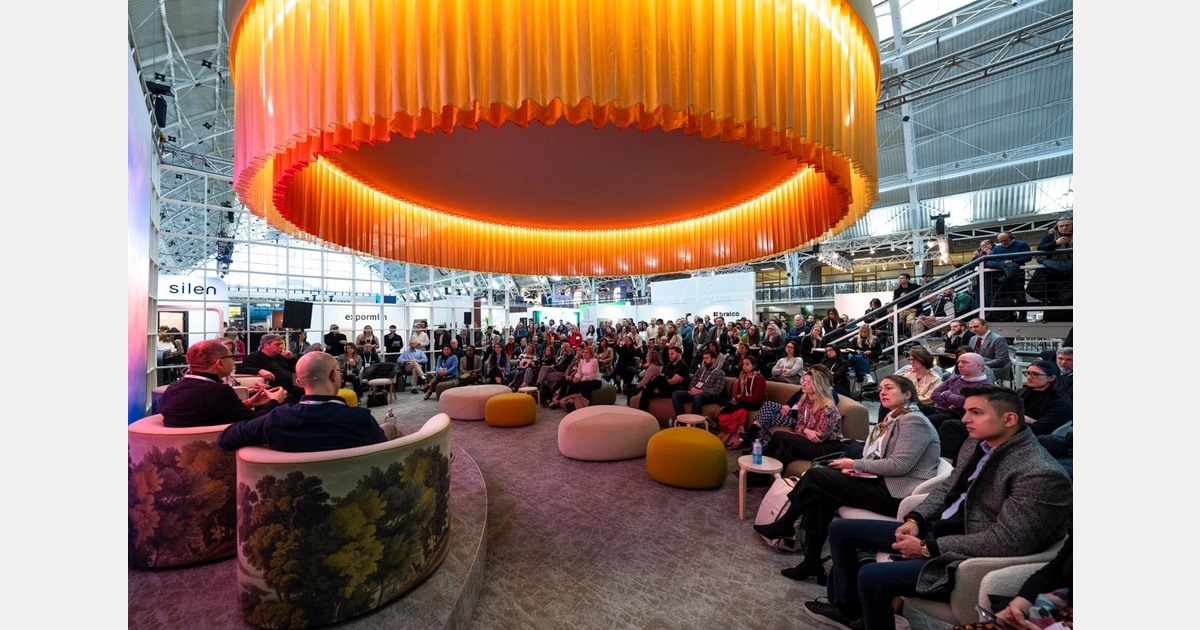
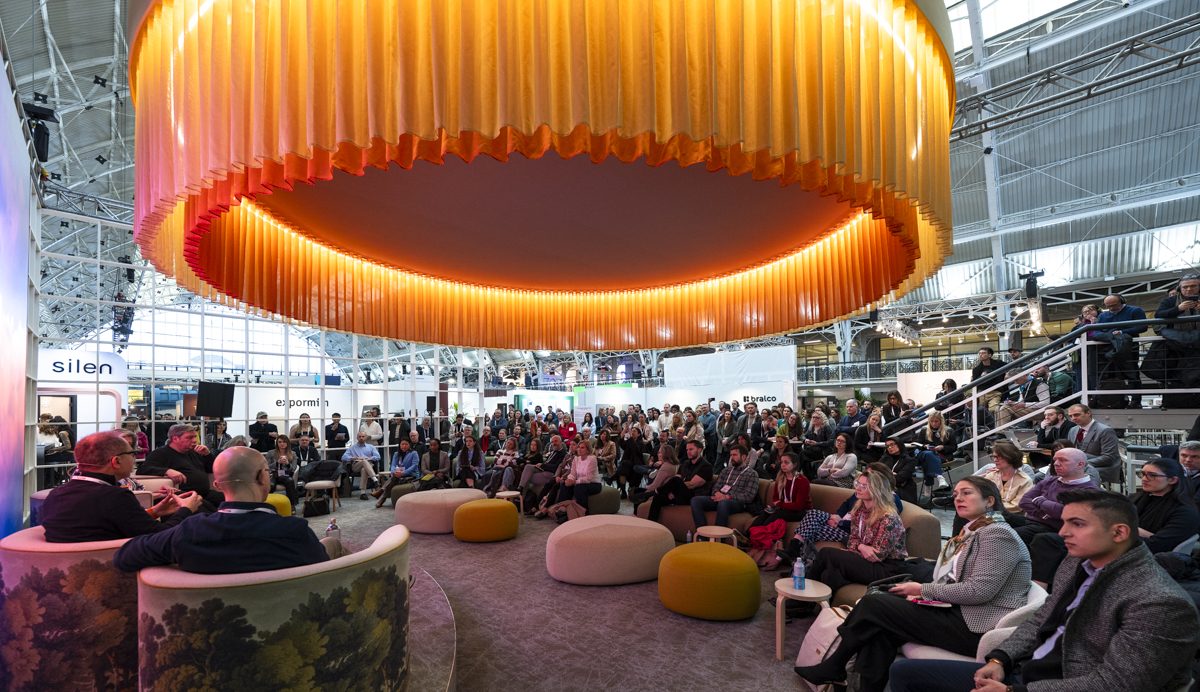
People are therefore at the centre of every change and every evolution. This is confirmed by Gensler and Area‘s concept for the Workspace Design Talks Lounge: the stage, the focal point of the event, creates a balance between the physical and digital worlds, but places relationships at the centre of attention, the only true reference point for any project.
link